
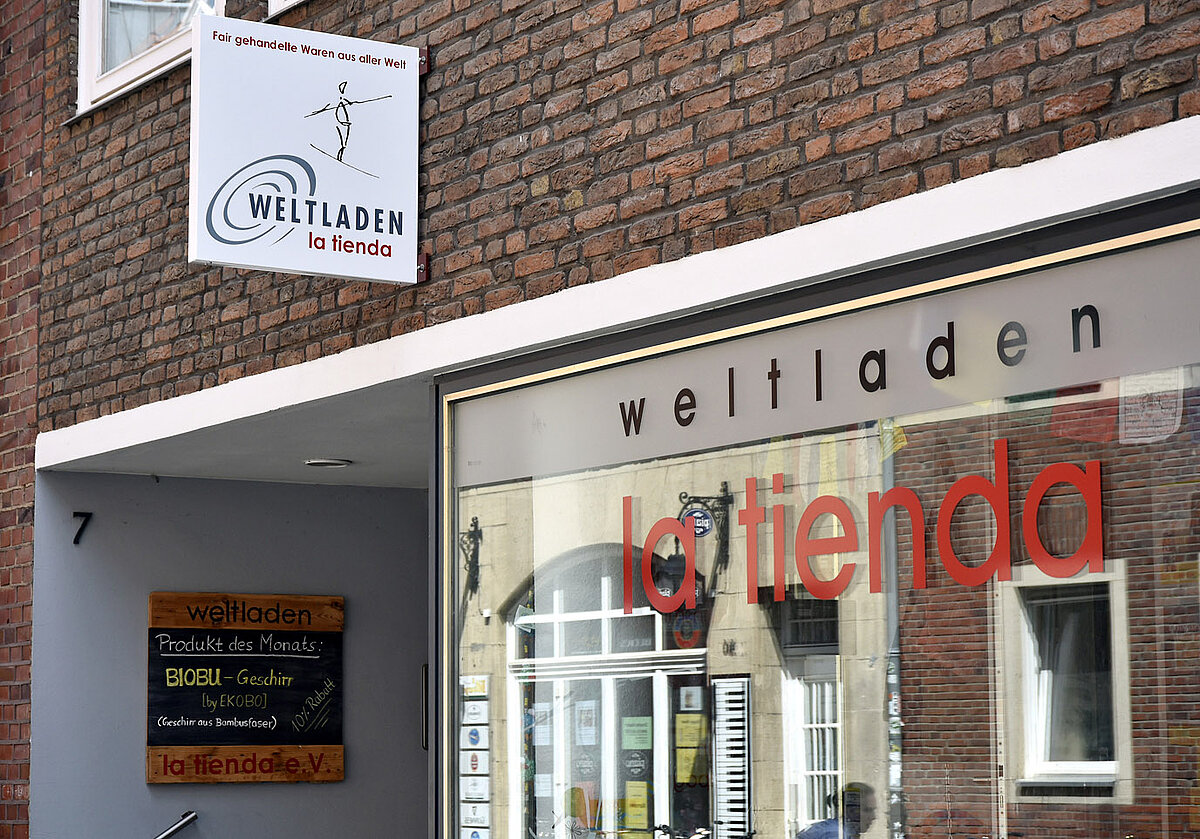
In 1993 the non-profit association la tienda e.V. was founded and is based on voluntary service and rests on three pillars:
- Sale of fair-trade products as well as advice and awareness-raising in the shop
- Public relations and campaign work
- Educational work
Our aim is to raise awareness of the unjust world trade structures that have affected many food producers since colonial times and, together with customers, to help these people build a secure livelihood through fair trade.
We have been active for many years in schools and extracurricular educational work to raise awareness and motivate people to take action through positive examples. We also use campaigns and events to draw attention to current development policy issues and want to contribute to positive change by supporting campaigns, for example.
Our Guided Tours
A City Tour That Challenges Consumerism
A city tour of a special kind: instead of churches and museums, we visit places of daily consumption. Where and how are our consumer goods, such as smartphones or clothing, produced? What direct impact does our purchasing and consumer behaviour have on people and the environment in the Global South?
The global production conditions of everyday consumer goods are critically examined and our own consumer behaviour is reflected upon. The main focus is on positive approaches, a broader awareness of global connections, personal responsibility and concrete alternatives for action for each and every individual. The interactive tour is based on a lively exchange and lively discussions.
We also offer a joint SDG--Tour in cooperation with the other groups in the network.
SDG City Tour for Adults
At selected locations in the Old Town, we’ll explore some of the 17 UN Sustainable Development Goals (SDGs) through topics such as food security, climate and water, textiles, sufficiency, fair trade, and/or women’s history, and examine how Münster is contributing to achieving these global goals. What do local businesses and initiatives contribute? In addition to many interesting facts, you’ll also learn what role your consumption habits and everyday behavior play—and how you yourself can easily make a difference.
This city tour was developed in collaboration with some of the network partners listed here, with funding from the North Rhine-Westphalia Foundation for Environment and Development and the Diocese of Münster.
More information about this tour is also available under the heading “Joint SDG Tour.”
SDG City Tour for Children
What does our food have to do with the climate? What is the Library of Things? What does poverty mean—here at home and around the world? And how can we live sustainably without having to give up everything?
On our interactive walk through Münster’s downtown, children ages 10–12 will explore these questions together. At four to five stops, they’ll discover examples of the 17 Sustainable Development Goals (SDGs) and learn how these relate to their own daily lives. At the stations, they’ll experiment, solve puzzles, discuss, and work together to find solutions: “Big” topics like nutrition, climate change, sustainable consumption, resource distribution, and social justice are presented in a child-friendly way, linking global issues to the children’s lives and familiar places in their daily routines. The tour thus playfully encourages children to develop their own ideas and take action themselves. After all, each and every one of us can make a difference!
The “SDGs for Kids” project is financially supported by the North Rhine-Westphalia Foundation for Environment and Development, the Diocese of Münster, and Brot für die Welt.
partially translated withDeepL.com (free version)
The individual goals cannot all be separated from one another and are of course also interlinked. Goals that our tours clearly cover are SDG 8:“decent work”, SDG 11:“sustainable cities & communities”, SDG 12: “sustainable consumption & production” and SDG 13 “climate protection measures”. However, fair trade alone, for example, as an alternative that we have taken up, naturally also addresses goals such as “no poverty”, “less hunger” and “gender equality”.
